
Russ vs. Rose: What if the Bulls drafted Russell Westbrook over Derrick Rose?
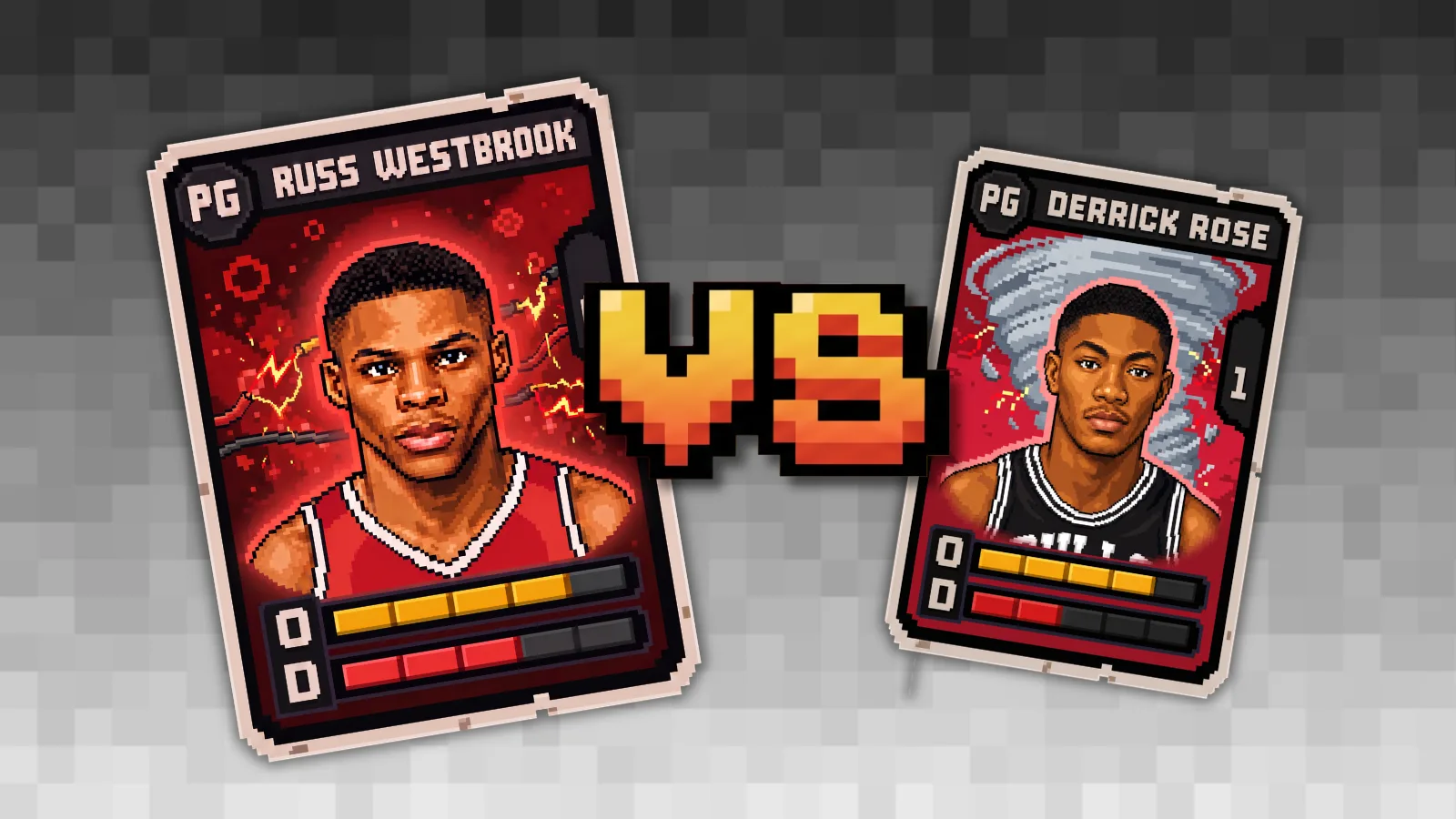
Russell Westbrook recently retired. No press conference, no farewell tour, just a three-and-a-half-minute video narrated by Michael B. Jordan. Classic Russ, never afraid to be different. I mean remember the outfits? Anyway, he finishes his career as the 2017 MVP. Fifth all-time in assists, 14th in points. The guy played until he was 37 and reportedly still had offers on the table. But he decided he was done and with it one of the more interesting pro careers. I'm not going to lie, Russ was one of my favourite players to watch. The sheer force he played with, I don't think I've enjoyed watching anyone dunk in-game as much as I've enjoyed Russ "yamming" it on people.
And look, I don't know about you, but the second that news hit, my brain did the thing it always does: it drifted back to the draft, in specific May 2008, and a Bulls war room in Chicago that had a decision to make.
Because here's the part people forget, both of their careers technically started at the exact same draft. Same night. Same green room. And Chicago, sitting on a golden ticket after one of the great lottery miracles in league history, had a real choice in front of them.
Grab a seat. We're getting in the time machine and going back to 2008.
Here's how our 2008 redraft board shakes out with the benefit of hindsight:
The sliding doors moment with … the Doctor
Let's set the scene, because the actual 2008 draft lottery is still one of the wildest "what are the odds" stories in NBA history. The Bulls entered that lottery with 1.7% odds, 1.7 percent, of landing the first pick. They leapt from ninth all the way to first. Pure, undiluted luck. And when the ping-pong balls landed that way, there was basically zero suspense about what came next: Derrick Rose, a kid from Englewood who'd starred at Simeon Academy on the South Side, was sitting right there. Local hero, generational athlete, hometown Bulls holding the pick. It would have taken an act of organizational self-sabotage for John Paxson and the front office to look anywhere else.
So they didn't. Rose went first overall. Michael Beasley went second to Miami (that's a what-if of a different kind). O.J. Mayo went third to Minnesota (immediately flipped to Memphis). And then, at four, Seattle took a UCLA combo guard out of Long Beach named Russell Westbrook, a guy so raw that some scouts had him going in the twenties just two years earlier. The Sonics franchise relocated to Oklahoma City before he ever played a game for them.
Here's your weird-coincidence detail: Rose actually beat Westbrook in real life before either of them played an NBA minute. Rose won the 2008-09 Rookie of the Year award, with Westbrook finishing fourth in that same voting. The two guards' careers were tied together from the jump: draft classmates, rookie-of-the-year rivals, two point guards who'd go on to define two very different versions of "generational talent."
The pivot
Picture it: a version of us, standing behind Paxson in that war room, May 2008, watching him pick up the phone to call it in. And instead of staying quiet, the team Doctor leans in.
"Take the UCLA kid instead."
"Westbrook? He averaged what, twelve points a game as a sophomore? Rose is the best player in this draft, maybe the best point guard prospect since Isiah."
"Yeah but his knees. They're no good Pax, they've got like 4 good years in them. Then who knows, maybe he'll tear his ACL. Then maybe a meniscus, then probably the other meniscus. Heck it might happen twice (in case you're not familiar with his medical history these all actually happened to D.Rose). He could play like 139 games total. This Westbrook kid is built like a ninja turtle, he is going to play until he's like 37."
Paxson stares at an x-ray of Rose's knee and then, because this is a fantasy and fantasies get to move fast, he picks up the phone and has a change of heart.
Longevity vs. peak: worse, honestly
Let's not dodge the hardest part of this argument, because it's the one Bulls fans will fight you on: Rose's peak, at its absolute best, was higher than anything Westbrook could have produced in a Chicago uniform, ever.
In 2010-11, Rose averaged 25.0 points, 7.7 assists and 4.1 rebounds on 44.5% shooting, won MVP as the youngest player ever to do it, and dragged a Bulls team to a league-best 62-20 record and the Eastern Conference Finals, the furthest the franchise had gone since Jordan retired. That's not just a good season. That's one of the more electric individual years the league has seen from a point guard, full stop.
Westbrook, over that same stretch of his career, was very good but not yet that. His third season (2010-11, the same year as Rose's MVP) he was 21.9 points, 8.3 assists, 4.6 rebounds, a fantastic season, All-NBA Second Team level, but not an MVP-caliber one. Westbrook's true peak didn't arrive until 2016-17 in Oklahoma City, when he averaged a triple-double for the season and won his own MVP. If you're grading pure ceiling, healthy prime Rose was scarier for stretches than anything Westbrook did before his thirties.
So: peak, real Rose wins. No amount of alternate-timeline spin should pretend otherwise.
Peak: Worse.
Availability and durability: waaay better
But here's where the whole equation flips, and flips hard, because availability is a skill, and it's one Rose tragically never got to show off. From his ACL tear in April 2012 through his eventual trade away from Chicago, Rose played just 139 out of a possible 362 games, a brutal 38% availability rate during what should have been the back half of his athletic prime. Big toe, low back, groin, ankle, both menisci, more ankle. The injury log reads like a body that betrayed him one joint at a time.
Westbrook, meanwhile, played 82 games in his rookie year, 82 in a lot of years, and finished with 1,301 career games across 18 seasons. He suited up deep into his late thirties. Simple subtraction: even if you conservatively estimate Rose's actual body would have held up marginally better wearing a different color of jersey (unlikely, since the mechanism was largely non-contact and structural), you're looking at a decade-plus gap in games played between the two of them. A Bulls team with Westbrook at the point isn't losing an entire prime to a knee that never recovers. It's getting a guy who shows up. Every year. For a long, long time.
Durability: Waaay better.
Offensive production across a career: better
Peak-for-peak, Rose wins one season. But stack full careers next to each other and the picture changes. Westbrook retires as the NBA's 14th all-time leading scorer and 5th in assists, with career averages of 20.9 points, 6.9 rebounds and 8.0 assists, and the all-time record for triple-doubles at 209. Rose's actual career averages sit closer to 17-3-4 across 16 injury-shortened seasons, weighted heavily by those brilliant, brief early years before everything unraveled.
Look at Westbrook's actual early trajectory for a second, because it's instructive: 15.3 points as a rookie, up to 16.1 with 8.0 assists in year two as the Thunder made the leap to a 50-win team, then 21.9-8.3-4.6 in year three. That's a real, gradual climb, the kind of career arc that compounds instead of one that gets interrupted. Give him the same runway in Chicago and there's little reason to think that growth curve looks meaningfully different; usage rate and shot volume would've been there for him just like they were in OKC, arguably even more so as the unquestioned engine of a Rose-less Bulls offense from day one.
Career offensive output: Better.
What Chicago loses: the part no stat sheet can capture
Here's where I have to be honest with you, because I don't think this what-if is as simple as "more triple-doubles, longer career, more good." Derrick Rose wasn't just a Bulls draft pick. He was Chicago's. A kid from Englewood who grew up watching Jordan and Pippen inside the same building he'd eventually play in, whose mother raised him and his brothers on the South Side, who went to Simeon, the same high school pipeline that's produced South Side basketball royalty for decades. When the Bulls retired his jersey this January, Joakim Noah didn't talk about box scores. He talked about it being a polar vortex and the building still being full. Rose himself said it wasn't ultimately about him; it was about "creating a synergy that somehow people from the city can pull from." That's not spin. That's what a hometown pick, gone right for even a handful of years, actually means to a fanbase.
Westbrook, for all his brilliance, is a Long Beach kid who played his college ball at UCLA. Nothing wrong with that; it's just a fundamentally different relationship. Rose's rise from a struggling neighborhood to the youngest MVP in league history, on his own team, in his own city, is the kind of story that turns a player into a civic landmark. There's no version of "we drafted the better long-term stat-sheet guy" that fully replaces what an entire city felt watching one of its own lead the Bulls back to relevance for those few golden years.
What Chicago loses: Real, and it doesn't show up in the box score.
What Chicago could have gained: Westbrook's fire
But let's not undersell what Chicago would have gotten in exchange, because "outsider" was never really the right word for how Westbrook plays basketball. This is a guy who screamed at hecklers, stared down entire arenas after a dunk, and treated a random Tuesday in January like Game 7 for eighteen straight years. That's not just a personality trait, it's a Chicago basketball trait. This is a city that fell hardest for a shooting guard who once threw hands with his own teammate in a practice drill over pure competitiveness and built a global brand on sheer force of will. Bulls fans didn't fall for Michael Jordan just because he was homegrown. They fell for him because he played like every possession was personal.
Westbrook is the closest thing the post-Jordan NBA has produced to that specific strain of fury. Every rebound is a personal insult if he doesn't get it. Every triple-double is chased like it's his first. Reporters spent nearly two decades trying to get him to explain the chip on his shoulder and mostly got some version of "why not." Drop that temperament into the United Center, night after night, for a franchise that's always romanticized players who compete like they've been personally disrespected, and it's not hard to picture a fanbase adopting him fast. Maybe not with the built-in hometown sentimentality Rose had on day one. But give it two or three seasons of him refusing to lose a jump ball to a seven-footer out of pure spite, and Chicago falls for him anyway. It just happens on the court instead of in the backstory.
Westbrook's fire: Better than the outsider narrative gives him credit for.
Projecting the timeline forward
Say Westbrook is the pick. The Bulls still have the pieces they actually built around Rose in real life (Joakim Noah, Luol Deng, and eventually Taj Gibson), plus the front office's actual 2010 free agency swing, when they aggressively (if unsuccessfully) chased the big names on the market before settling for Carlos Boozer. None of that infrastructure changes. What changes is the engine.
By year three or four, roughly the 2011-12 season in this timeline, you've got a Westbrook-Noah-Deng-Boozer-Gibson core that's healthier and more explosive in transition than the real Rose-led group, minus the single signature MVP year, but without the injury collapse that gutted the roster right as it was supposed to peak. Extend it two more seasons into 2013-14, when the real Bulls were trying (and failing) to survive without Rose, and you've instead got a Westbrook entering his prime, still just 25, playing alongside a core that never had to burn two seasons rebuilding around a rehab timeline.
Here's the part that gets really interesting, though: a healthy, durable Westbrook changes the front office's entire calculus, not just the on-court product. The real Bulls spent years hoarding draft assets and cap flexibility specifically because they knew they might need to replace or supplement an injury-prone franchise player at some point. In this timeline, they don't have that fear hanging over them. A GM who trusts his point guard to be on the floor for 75-plus games a year can afford to be aggressive instead of cautious. Picture Chicago packaging future first-rounders and expiring contracts around 2012 or 2013 to chase a disgruntled star the way they actually tried (and failed) to land Carmelo Anthony back in 2011. With Westbrook already locked in as the engine, the Bulls aren't trying to build an entire identity around a rescue plan. They're shopping for a co-star to put next to a guy who's already proven he shows up. That's a fundamentally different, more aggressive front office than the one Chicago actually had, and it's one more reason the Westbrook timeline probably produces more total playoff runs, even without a signature MVP season anchoring it.
Another wrinkle in the time continuum that might actually make him better: real OKC Westbrook spent his prime sharing a locker room with Kevin Durant, arguably the most efficient high-volume scorer the sport has ever seen, and later with James Harden, who by 2012 was already the league's premier off-the-dribble shot creator. That's an incredible luxury, but it's also a crutch. When possessions stall or a bad shot needs to go up, it's a lot easier to just chuck a contested three and let Durant clean up the next four possessions. For his career, Westbrook shot just 30.8% from three, a number that got worse, not better, the deeper he got into seasons where he had that kind of scoring cushion around him. Without Durant and Harden absorbing shots and covering for his misses, a Bulls-context Westbrook doesn't have that luxury. He's the only above-the-rim shot creator on the roster, next to a defense-and-rebounding big in Noah and a solid-but-limited scorer in Deng. Simple logic says his shot diet has to change: less standing-around, low-percentage, "well, somebody has to shoot it" three-point volume, and a lot more of what he was always genuinely elite at, which is putting his head down, drawing contact, and getting all the way to the rim. Less bricklaying from twenty-four feet, more of the drive-and-dish, drive-and-dunk game that made him a walking highlight reel in the first place. It's not guaranteed. But it's not a stretch either. Necessity has a way of sanding down bad habits, and a Bulls team that needs him to be efficient rather than just prolific might have gotten a leaner, meaner version of Westbrook than OKC ever actually saw.
Less 'bricky' Westbrook vs hobbled Rose: Better.
Closing Thoughts
It's impossible to actually know what happens in a universe where the ping-pong balls bounce the same way but the card read out of the envelope says a different name. Maybe Westbrook in a different system never becomes Westbrook. Maybe the fire doesn't translate the same way in a different jersey, on a different stage. Alternate history is a fun exercise precisely because it can't be checked.
But watching that retirement video, it was hard not to just sit with how genuinely fun the guy was to watch for eighteen years, regardless of which city he did it in. This wasn't a player who managed his career, he hit 37 years old still barreling into the paint like people owed him money. He racked up more triple-doubles than anyone who has ever played basketball, not by accident, but by refusing to let a single one slip away out of pure stubbornness. Whatever timeline you drop him into, that competitive engine was never turning off. That's the real takeaway here, more than any Chicago-specific what-if: the league just said goodbye to one of the most relentlessly entertaining players it's ever had, a guy who made "why not" into a philosophy and then backed it up for two straight decades.
Derrick Rose gave Chicago one perfect, unforgettable year, and a legacy the city clearly still cherishes. But somewhere in an alternate 2008, there's a version of the Bulls that got to watch that same fire, that same refusal to slow down, suit up for them every single night for the better part of two decades. Would they have loved him the way they loved Rose? Maybe not right away. But eighteen years of a guy who plays like his hair's on fire has a way of winning a city over eventually. Chicago just never got the chance to find out.