
Brown vs Ben: A Case of What If for the Sixers
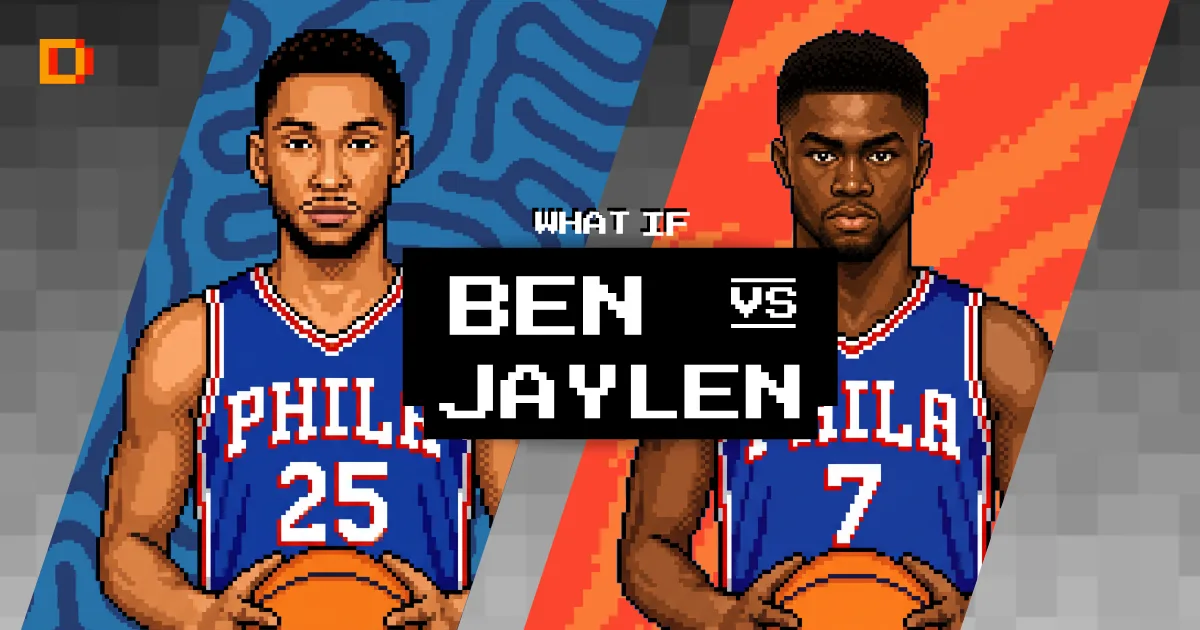
The case for Brown vs Ben is less about precedent and more about what if. What if Philadelphia already had Jaylen Brown ten years before they actually traded for him this summer? What if the guy who just got shipped to the Sixers for Paul George could've been wearing the jersey since 2016? Buckle up, because we're getting in the Delorean and heading back to a gymnasium in Brooklyn on draft night.
In June 2016, the 76ers had the No. 1 overall pick, and they used it on Ben Simmons, the do-everything LSU forward with point-guard vision in a 6-10 frame. Three picks later, Boston scooped up Jaylen Brown out of Cal. Nobody blinked. Simmons was the consensus best prospect in the class, a generational passer who could theoretically guard four positions. Brown was the toolsy, slightly raw wing who needed a jumper. The pick made sense on paper. It just didn't make sense for Philly's specific, chaotic reality.
Here's how our 2016 redraft board shakes out with the benefit of hindsight:
The real-world defendants
With the benefit of hindsight this scenario could have played out so differently for both players, teams and NBA fans alike.
Philly drafting No. 1 in 2016 was possibly the worst possible landing spot for the supremely gifted, raw 19-year-old Ben Simmons. He needed patience, structure, and shooters around him to accentuate his strengths and minimise his weaknesses while he learned on the job.
The issue for Big Ben: Sam Hinkie's "Process" had just imploded into open front-office warfare, Bryan Colangelo was stepping in as the new de facto voice of the franchise, and the roster around the pick was a science experiment, Jahlil Okafor, Nerlens Noel, and Joel Embiid, three bigs who couldn't functionally play together, with a head coach in Brett Brown who had zero infrastructure to protect a rookie's confidence. Simmons broke his foot in a preseason scrimmage that September, missed the entire 2016-17 season, squashing all the confidence and momentum he'd built in his year at LSU. By the time he actually debuted, the pressure of "the guy Philly tanked three years for" was already baked into every headline. Plus, it's Philly, a notoriously critical fan base known for not giving two sh*ts about their players' feelings.
Boston, meanwhile, was the most stable organization in the sport. Danny Ainge had a coach in Brad Stevens who'd already proven he could develop young guys without burning them, a two-way wing in Jae Crowder to soak up minutes, and an All-NBA caliber lead guard in Isaiah Thomas who didn't need the rookie to be the engine on day one. Brown got to come off the bench, play 20 minutes a night, and simply learn the league instead of being asked to save a franchise.
The funny thing is, these two have history that predates the draft. They met head-to-head in high school as the No. 1 and No. 2 ranked prospects in the country:
The what-if sliding doors moment
Imagine an alternative reality where the night before the draft Sam Hinkie and Brett Brown are at a sports bar.
"You sold on this Simmons kid?", says Brown.
"I mean yeah, he's a generational talent, you've got concerns?", Hinkie responds looking confused.
In this scenario Brown's been tipped off by some weird kid in a red puffer coat about how this all unfolds. He casually slips, "I worry about this kid's resilience, Philly fans are cruel Sam."
Annoyed, Hinkie responds, "Well then who would you prefer?"
"That Brown kid is raw, but his athleticism, intelligence and grit are off the charts. We could use that with this group. I can find a point guard through free agency."
For whatever reason, Hinkie agrees and 24 hours later, Adam Silver walks out, and instead of "with the first pick in the 2016 NBA Draft, the Philadelphia 76ers select Ben Simmons," it's: "the Philadelphia 76ers select Jaylen Brown, California." Three picks later, Boston sitting there with the No. 3 pick takes the Australian playmaking savant everyone still considers the best prospect in the class. Wild! Two franchises, two totally different pressure environments, two totally different outcomes.
Let's break down what would've happened to both of them, category by category.
Part One: Jaylen Brown in Philadelphia
Coaching: Worse on paper, but Brown offsets it. Brown actually got Brad Stevens for a decade, a coach with total organizational trust who could afford to bring him along slowly. In Philadelphia, he's playing for Brett Brown, a coach managing a front office that changed leadership essentially every year, from Hinkie to Colangelo to Elton Brand. That's a real downgrade in institutional stability. But Brown isn't a player who needs his hand held to develop good habits. He's on record as one of the more cerebral, self-directed guys in the league, a Cal graduate who reads philosophy in his spare time and has always talked about his career in deliberate, long-term terms rather than reacting to whatever noise is happening that week. A player who builds his own structure internally is a lot less dependent on his coach having organizational job security. Brown likely still develops on a normal curve here, just with less hand-holding.
Team Chemistry: This is where Brown actually thrives. Simmons' actual Sixers tenure was defined by reported tension with Embiid, a fanbase that turned on him after the infamous pass-up in Game 7 of the 2021 Eastern Conference Semifinals, and a trade saga that ended with him refusing to report to camp. That meltdown wasn't just about the roster around Simmons, it was about temperament. Simmons visibly struggled with public criticism and, by his own admission, dealt with real mental health strain under Philadelphia's spotlight. Brown is built differently. He grew up in circumstances that forced early independence, has spoken candidly and confidently about race, business, and the league's power structure without flinching from controversy, and has never shown the kind of public fragility that defined Simmons' unraveling. Philadelphia fans are demanding, but they respect a player who competes and talks straight, and Brown does both instinctively. Where Simmons wilted under "why won't you shoot," it's easy to picture Brown meeting that same noise with the same even-keeled resilience he actually showed through real playoff adversity, trade rumors, and a very public running mate dynamic with Tatum in Boston. He's already proven he can operate under pressure without cracking. Philadelphia doesn't break that. If anything, it's the kind of fanbase that comes to respect him precisely because he doesn't flinch.
Team Offense: Worse, at least early, but likely faster development, not slower.
Brown's actual rookie year, 6.6 points on 32.1 percent shooting from three, was quiet by design, because Boston didn't need him to create. The usage rate progression tells the real story here. Brown opened his career around an 18 percent usage rate as a rookie, buried in a crowded, veteran Boston rotation behind Isaiah Thomas, Avery Bradley, and Al Horford, and it took him roughly five full seasons of gradual, incremental increases, into the low-20s by year three, mid-20s by year four, before finally crossing 29 percent usage in year five, to become a true first-option engine. That's a slow, patient apprenticeship, and Boston could afford to run it that way because they already had established scorers. Philadelphia in 2016-17 offered no such luxury.
Ben Simmons walked into that vacuum as a rookie and immediately posted a 22.2 percent usage rate, higher than anything Brown saw in his first three actual Boston seasons combined, simply because the Sixers had almost nobody else who could create offense next to Embiid. Drop Brown into that same starved offense, and he's not climbing a five-year usage ladder one rung at a time, he's getting force-fed reps in the low-to-mid 20s from day one.
The raw shooting numbers probably still look rough that first year, since more touches for an unpolished 19-year-old also means more live-game mistakes. But usage is also just reps, and reps are how young wings sharpen a jumper and a handle. A player who's already shown, in real life, that he can absorb criticism and self-correct without cracking is exactly the kind of player who benefits from being thrown into the deep end early instead of paddling in the shallow end of a crowded veteran roster for half a decade. Philadelphia's dysfunction, in this narrow sense, might have functioned as an accelerant rather than a hindrance, potentially compressing what actually took Brown five seasons into two or three.
Team Defense: Better, and immediately.
This is the one category where Brown's real skill set travels regardless of zip code. He built a reputation as one of the league's better wing defenders early in his career, guarding LeBron James and Kevin Durant in playoff series as a 22-year-old. Slot a 6-6, 220-pound wing with that motor next to Embiid from day one. Simmons was no slouch but Brown as a true wing defender and Philadelphia's actual defensive infrastructure, a top-10 defense multiple years in the Process era, gets sturdier immediately.
Star Power & Ceiling: Better. Real-world Brown is a five-time All-Star, a two-time All-NBA Second Team selection, and the actual 2024 Finals MVP on a championship team, averaging 20.8 points, 5.4 rebounds and 5.0 assists across that five-game Finals win over Dallas. Put that same trajectory next to a healthy Embiid for eight extra seasons starting in 2016 instead of 2026, and the ceiling only goes up.
The verdict on Brown in Philly: Better
Yes, the infrastructure is worse and the early shooting numbers are probably rough, but the argument that Philadelphia chews up young stars assumes every young star has Simmons' temperament, and ignores what usage rate data actually shows about how these two developed.
Brown's real career was a slow, patient five-year climb from an 18 percent rookie usage rate all the way to a 29-plus percent peak, largely because Boston never needed to rush him. Philadelphia rushes everybody. Simmons hit a 22.2 percent usage rate as a rookie out of necessity, and Embiid, for what it's worth, posted a 35.8 percent usage rate in his own rookie season, reportedly a higher mark than Shaquille O'Neal, David Robinson, or Hakeem Olajuwon ever posted in any season of their careers, because that starved 2016-17 roster simply had nobody else to give the ball to.
That's the environment Brown would have walked into: a team that has no choice but to hand a talented rookie real offensive responsibility immediately. For a player with Brown's grit and self-awareness, that forced acceleration is a feature, not a bug. He's got the temperament to manage the fanbase and the noise in a way Simmons never could, which means Philadelphia's chaos does less psychological damage to him while its sheer offensive need hands him the reps that actually build a star faster than a slow bench apprenticeship would. Given the choice, Brown in Philly might genuinely be the better outcome for both player and franchise.
Part Two: Ben Simmons in Boston
Coaching: Better, and it's not close. Simmons trades Brett Brown's fragile, job-insecure situation, the one that actually helped unravel his confidence, for Brad Stevens' total organizational trust. The same coach who patiently brought a young Jaylen Brown along off the bench is exactly the kind of coach a passing-first, shot-shy rookie needs.
Team Chemistry: Better, waaay better. Simmons' actual Sixers tenure was defined by reported tension with Embiid, a fanbase that turned on him after the infamous pass-up in Game 7 of the 2021 Eastern Conference Semifinals, and a trade saga that ended with him refusing to report to camp. Drop him into Boston instead, where Al Horford and Marcus Smart actually set a standard of accountability without melodrama, and it's not hard to see stability and give him a stable platform to learn good habits.
Team Offense: Genuinely better, and here's the part people undersell.
Simmons' real problem was never just that he couldn't shoot. It was that Philadelphia asked him to be the primary shot creator and de facto point guard on a roster that, for years, had almost no other way to generate offense, which meant defenses could sag off him without consequence and dare him to beat them from outside. Boston solves that structurally, not cosmetically. Slide Simmons into a Celtics team that already had Isaiah Thomas and Avery Bradley as shot creators in 2016, then realistically still lands Kyrie Irving via trade the following summer and still drafts Jayson Tatum in 2017, since that pick swap with Philadelphia was a separate transaction from the Brown-Simmons pivot. Suddenly Simmons isn't the engine, he's a play-finisher and secondary initiator surrounded by three legitimate shot makers. Tatum in particular is a much better long-term frontcourt partner for Simmons than he ever was for Brown, since Tatum's shot creation and shooting gravity are exactly what a non-shooting point-forward needs next to him, while Brown and Tatum, in real life, occasionally bumped shoulders over who should have the ball late in games. Simmons and Tatum, by contrast, are functionally a two-way fit: one needs the ball and shooting room to attack downhill, the other provides it.
Team Defense: Great, and this is where his confidence gets built.
Real-world Simmons was a legitimately elite, switchable defender, a two-time All-Defensive selection who could guard four positions, and it's worth remembering that this part of his game never wavered even as everything else around him fell apart. In Boston, next to Horford and Smart and, eventually, Tatum, Simmons gets to lean into that identity from day one instead of it being an afterthought behind constant "why won't you shoot" noise. A player who's already excelling on one end of the floor, and getting praised for it by a fanbase and locker room that values winning plays over highlight scoring, is a player whose overall confidence is being built up rather than chipped away. That matters for the next part.
Star Power & Ceiling: Better, with a specific, grounded case for it.
Real-world Simmons never developed a jumper at all, going 0 for 17 from three through his first two full seasons and finishing his actual career at a rough 13.9 percent from deep and 59.2 percent from the free-throw line, numbers that basically never moved because he had no space, no shooting margin for error, and a fanbase magnifying every miss. A more stable, less pressurized environment doesn't turn him into a knockdown shooter. But it does remove the two biggest obstacles to gradual improvement: defenses that live in the paint against him, and a psychological spiral every time he airballs one. Free-throw shooting in particular tends to track confidence and repetition more than raw touch, and Simmons actually improved his real free-throw percentage in stretches when he wasn't under the microscope. Give him that same trajectory in a lower-pressure gym, with shooters spacing the floor around him and a coach who never benches him for missing jumpers, and a believable outcome is a Simmons who climbs from the mid-50s at the free-throw line as a rookie into the high-60s or low-70s by his mid-20s, and who starts actually letting the open three go instead of passing up every one, even if he only ever converts around 30 percent of them. Never a real threat. Just consistent enough that defenses can't fully ignore him anymore.
The verdict on Simmons in Boston: Better
Smoother, steadier, and probably a longer, calmer career, with a real, stat-backed case that shooters around him and a defense-first identity to lean on actually get him further as a scorer than Philadelphia's sink-or-swim approach ever did.
Extrapolating the Timeline Forward
With both tracks laid out, let's fast forward to, say, 2019, and follow Philadelphia's side of the split specifically, since that's the roster actually building around a homegrown Jaylen Brown. In the actual timeline, Philadelphia spent that offseason trying to build shooting around Simmons and Embiid, eventually swinging deals for Jimmy Butler and Tobias Harris. In this one, they're building around a 22-year-old Brown who can already shoot and defend, plus Embiid, and still have the actual real cap sheet flexibility Colangelo and later Elton Brand had to chase shooters. A realistic extended roster: Embiid at center, Brown and a healthy, non-tanked-for-years JJ Redick-style floor-spacer at the wings, and the actual 2017 draft class (Markelle Fultz's real draft slot, swapped for a shooting guard who fits better, or a trade-up for a shooter like Donovan Mitchell, who Philly reportedly scouted) at point guard, and suddenly Philly has a sustainable roster and doesn't spend a decade chasing fading star players.
It's impossible to say for certain that any of this happens exactly this way. Maybe Brown gets hurt in Philly's chaos too, maybe Simmons thrives with more shooting around him in Boston and never has the confidence collapse at all. What we do know, from the actual, real, factual record, is that context mattered enormously for both of these guys, and Philadelphia just spent a first-round pick's worth of assets and Paul George's expiring max deal to get, a decade late, the player they could have already had. Ben Simmons, for his part, is still out there now a free agent who never quite got the runway he needed. It's an interesting what-if moment.