
Would Steph Curry Get Drafted in 1992?
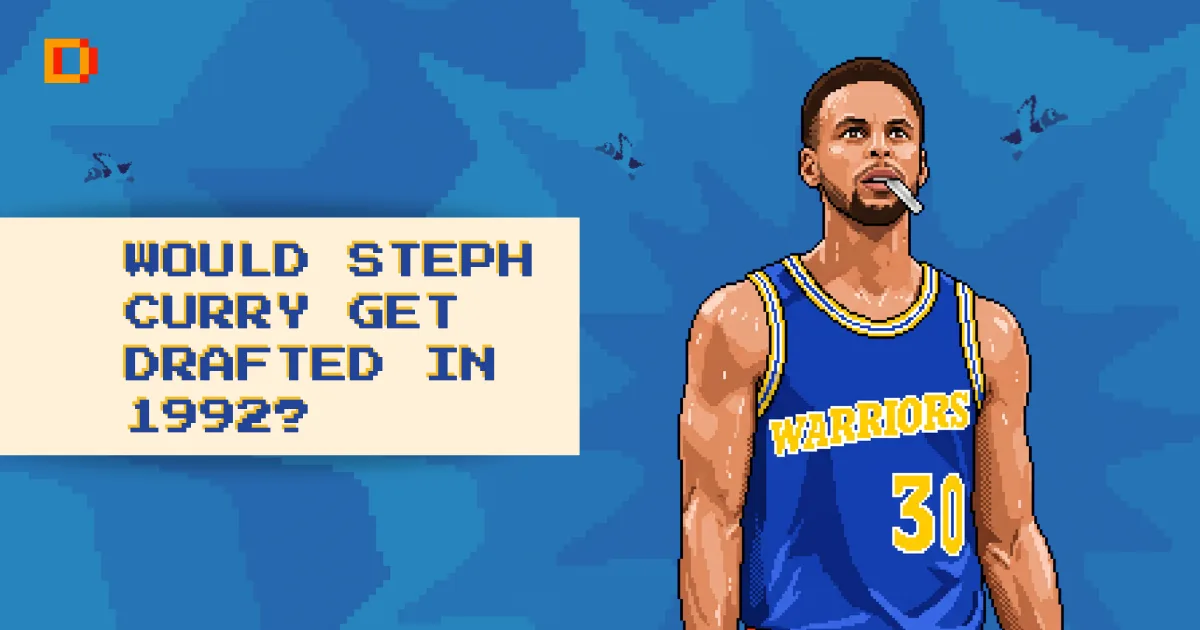
Coaches in the 90s hated 3 pointers. Like really hated them. In the 1990-91 season the NBA's most efficient offense the Chicago Bulls shot only five, yes five 3pt attempts. As Larry Bird once commented:
We never thought of that. We wanted to pound it inside.
Which brings us to 'Shef Curry", Mr Threepointer. When Curry entered the league 50% of his 20 shots per game came from 3pt land. That was his thing, his calling card. Which begs the question, would a skinny three point loving shooting guard who can't defend from a liberal arts school have been drafted in the ground and pound 90s?
Grab some chlorophyll because we're getting Steph into the Time Machine. Join us as we break down whether Stephen Curry, arguably the greatest shooter in basketball history, gets drafted in the year 1992.
The 1992 Draft: You can't teach tall
It's draft night and everyone already knows who the number one pick will be. It's Shaquille O'Neal. This draft was arguably stacked, the top three picks were considered can't-miss prospects. In fact the 1992 draft was the only draft where the first three picks were Centers. Only three players drafted in the first round were under 6-6.
Team's in that era saw it as a gimmick, something belonging to the college game or worse the ABA.
In case you haven't guessed teams were obsessed with size in the 90s. This was the scouting era of "you can't teach tall". And coaches loved them some beefy post players.
Something they're not obsessed with, the 'trey'. Let's pause for a quick basketball history lesson.
Once upon a time NBA teams hated the long ball. There were many reasons. The biggest reason was the coaching. Coaches in the 90s came up in the 70s and 80s when the three didn't even exist or was seen as a gimmick. NBA offenses as Shaq likes to remind us were focused on "touches in the paint". Inside out offense was the norm, lauded for being more efficient. As Larry Bird once acknowledged most players didn't even practice threes.
There were exceptions of course, the "three point specialist" was beginning to emerge. Michael Adams of the Nuggets was once such pioneer. He led the league in the three point attempts for 4 seasons in the era as he attempted to carved out a niche to maximized his 5"10 frame. However most of these guys were relegated to being "instant offense" off the bench. Yup players like Steve Kerr and ahem Dell Curry were used as a desperate tactic by coaches late in a game when their team was down. They got a few shots, if they missed there were benched, such was the life.
The case for drafting Stephen Curry
Bringing it back to the '92 draft lets put ourselves in the baggy suits of the league's GM's. Who is going to prioritise Steph and invest draft capital? Consider for a moment that even in the 2000s when teams liked the three pointer and teams had increased three point attempts to upwards of 20 per game Steph was only drafted 7th overall.
As Tim Tebow infamously said "it only takes one team" so let's find the team that wants to invest in the potential of 3 point specialist. From 1989 to 1992 only five teams averaged more than nine three pointers per game. Using three point attempts as a qualifying criteria lets consider these five teams as the potential suitors and evaluate their situation. That top 5 was the Pacers, Rockets, Bucks, Blazers, and wait for it, the Warriors.
The highest 3 point usage team over the three years leading into the 1992 draft was the Indiana Pacers averaging 10 attempts per game. Indiana had only the 14th overall pick. Though under .500% Indiana were still a playoff team. As we know playoff teams typically don't pick developmental types. Especially when they already have a strength in that skill set. In this case, Indiana featured arguably the 3 point pioneer Reggie Miller (4.2 attempts per game) and Chuck Person (4.4 attempts per game). They also featured Michael Williams at the point averaging 15ppg and 8.3apg. Indiana are out.
Number two is the Houston Rockets led by Hakeem "The Dream" Olajuwon. Talk about your 'paint touches' focused offense. They have the 11th overall pick and pick 41. While they drafted in the lottery it wasn't because they were a bad team, a down year thanks to Hakeem being injured and a coaching change they're still right in contention for a title. They already have their point guard of the future in Kenny Smith not to mention featuring their own 3 point specialist in Vernon Maxwell. He's shooting 6.1 attempts per game and averaging 17 points per game in the 90-91 season. Houston are out.
Next up the Bucks. Ok the Bucks might just have done, here is why. In '91 offseason the Bucks signed a post dominant former MVP player Moses Malone. The coach Del Harris had previously coached Malone in Houston where they combined to make Harris the winningest coach in Rockets history and nearly took a title from the Boston Celtics dynasty. Safe to say he liked post oriented offense. Malone was signed to replace SG Ricky Pierce and his 22ppg on 49, 39, 90 percent averages who had just helped them to a 48-34 record. I'm sure he felt fine about it since his backcourt featured Russell Westbrook lite in Alvin Robertson (13.6ppg, 5.7rpg, 5.5apg and 3spg) and Jay Humphries (15ppg and 6.7apg). But the season didn't go well and Harris resigned, and the Bucks sucked. In the 1992 draft the Bucks have two first round picks, 8 overall and 23 overall.
"With the 8th pick the Milwaukee Bucks select Todd Day shooting guard from Arkansas." Here's why they don't pick Steph. The new coach Mike Dunleavy. Coach Harris also had his own 3 point hitman 6"7 Dale Ellis who averaged 19 points off the bench on 3 attempts per game. Only 3? It's the '90s ok, it was a low bar. Bucks are out.
Then there were 2. The Blazers are a straight no, they're in their prime competing for a title and already feature two 3 point specialists in Terry Porter and Danny Ainge. Enough said.
Which leaves the Warriors. Could it be, are they destined to be? Maybe not. The 1990-91 season was the second of the sensational "Run TMC" featuring Tim Hardaway, Mitch Richmond and Chris Mullin. The trio averaged over 70 points a game. Unfortunately rebounding and defending kind of held them back. So in the following season, Don Nelson traded 23ppg 6"5 Mitch Richmond for 6"8 Billy Owens citing that they needed more height to compete and get better on defense. Are you picking up the trend here? But it worked, that season Don Nelson won Coach of the Year and the Warriors won 55 games. So I ask, would a team with title aspirations that is already flush with offense prioritize the potential of a 3 point specialist, I think not.
Ok, but what if other teams wanted to get in the 3 point game?
Ok fair point, but here is another challenge we have with Steph. His height, weight and speed while not a liability wouldn't have been considered an asset. He was a classic tweener. Tweener was dirty word in the 90s. Scouts even in the 2000's didn't know if he was shooting guard or a point guard. Curry wasn't considered a natural point guard coming out of Davidson because he had to create so much offense he never got the chance to showcase his passing ability on a consistent basis. In the 90's position mattered. If you couldn't fit the mold, teams didn't know where to slot you, and when scouts don't know where to slot you, they slide you down the board. A 6'3" guy who's too slight to guard bigger twos and, in the eyes of a '92 scout, "just" a shooter who hasn't proven he's a lead ball-handler? That's a role player projection at best, not a lottery pick. In an era obsessed with size, position, and paint touches, Curry checks almost none of the boxes GMs were drafting for.
So, does Steph get picked in 1992? Almost certainly, just very late, and by the wrong team. He's not going in the lottery, and he's probably not even a lock for the first round. He's a second-round flier, the kind of prospect a team stashes and uses in mop-up minutes, exactly like Dell Curry and Steve Kerr before him, guys who had to fight for a role as instant-offense specialists off the bench. It's not hard to imagine a world where Steph Curry never becomes Steph Curry, where he's miscast as a small two-guard buried on a bench somewhere, a career "three point specialist" footnote rather than the guy who reinvented the sport.
Which is really the whole point of the exercise: greatness isn't just about talent, it's about landing in the right era, on the right team, with the right coach who's willing to bet on something the league hasn't valued yet. Steph got lucky he was born in 1988 and not 1968. Thirty years earlier, the same skillset that broke basketball might never have gotten off the bench.