The 1996 Redraft: The Greatest Draft of All Time?
June 26, 1996. Continental Airlines Arena. A skinny kid from Georgetown named Allen Iverson goes first overall, kicks off a cultural revolution and absolutely nobody in that building has any idea they're about to witness the single most loaded draft class of the modern era walk across that stage. Three MVPs. Five Hall of Famers already inducted with more coming. Eleven All-Stars. Eight players who made All-NBA teams, the most of any draft class ever assembled. A Finals rivalry (Kobe vs. Iverson, 2001) baked in before either of them had played a single regular season game. This class is usually ranked second all-time behind 1984 (Jordan, Hakeem, Barkley, Stockton), and honestly on some days I'd argue it deserves the top spot. On a scale of "fun" to "an absolute war crime against opposing GMs," 1996 is a 9.5. The only thing keeping it from a perfect score is how badly some of these teams botched the board, genuine top-10 talents fell into the teens, a top-3 all-time defender went completely undrafted, and at least three franchises are still explaining themselves to their fanbases thirty years later. So let's fix it. DeLorean's warmed up. Let's go back to Jersey.
If you need a reminder of just how much talent walked across that stage, roll the tape:
The Real Draft: A Quick Recap
Here's what actually happened, for those of you who need the refresher (or weren't alive yet, which, rude). Philadelphia took Iverson first, which, fine, no notes, he won Rookie of the Year and an MVP. Toronto, an expansion team that didn't even exist a year earlier, took Marcus Camby second. Vancouver, the other expansion outfit, grabbed Shareef Abdur-Rahim third and actually nailed it. Milwaukee drafted Stephon Marbury fourth and immediately shipped him to Minnesota for Ray Allen, who Minnesota had just taken fifth, a same-night draft-night swap that still makes zero sense typed out loud. Boston took Antoine Walker sixth. The Clippers took Lorenzen Wright seventh. New Jersey got Kerry Kittles eighth. Then things get ugly: Samaki Walker at 9, Erick Dampier at 10, Todd Fuller at 11 (this one still keeps Warriors fans up at night), Vitaly Potapenko at 12. Charlotte took Kobe Bryant 13th and traded him to the Lakers for Vlade Divac before he'd even worn the uniform. Sacramento got Peja Stojakovic at 14. And Phoenix, bless them, actually got it right at 15 with Steve Nash. Undrafted entirely that night: a 6'9" defensive menace out of Virginia Union named Ben Wallace, who would go on to win four Defensive Player of the Year awards. Let that marinate.
Now let's rebuild the board the right way: best player who fits the need, weighted toward peak dominance but not sleeping on the guys who were still great a decade later.
Here's how our 1996 redraft board shakes out with the benefit of hindsight:
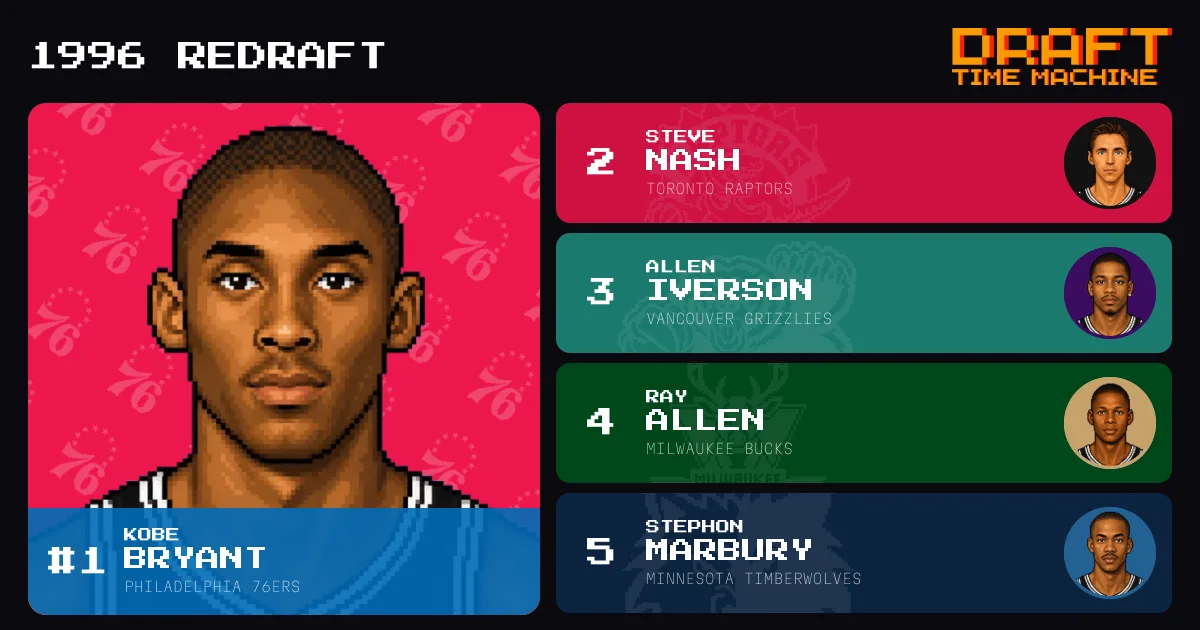
1. Philadelphia 76ers: Kobe Bryant, SG (Lower Merion HS)
Real pick: Allen Iverson
Look, Iverson was a legitimately great pick and this isn't a knock on him: MVP, four scoring titles, dragged a roster of role players to the 2001 Finals by himself. But Philly's actual need in 1996 was a foundational franchise cornerstone who could win at the highest level for two decades, and nobody in this class did that better than Kobe. Five championships, two Finals MVPs, a regular-season MVP, eighteen All-Star nods, fifteen All-NBA selections including eleven on the First Team, twelve All-Defensive teams. Iverson never won a title; Kobe won five and is a top-5 all-time scorer doing it. Philly had zero infrastructure in '96, and taking the guy whose game (and ego) was engineered to eventually demand and win championships is the move, even if it means Kobe never becomes a Laker and the entire 2000s NBA timeline gets rewritten.
2. Toronto Raptors: Steve Nash, PG (Santa Clara)
Real pick: Marcus Camby
Ok, ok, Nash over AI, I get it but before you lose it, hear me out. An expansion franchise trying to build an identity in a country that thinks basketball is a rumor takes the actual Canadian point guard who would go on to win back-to-back MVPs? The marketing department dines on this for a decade. Nash averaged double-digit assists multiple seasons, he led the league in assists five times, and ran the most beautiful offense basketball has ever seen (personally biased here as Nash is my GOAT). Camby was fine, a DPOY down the line, but a rim-running big was never going to sell tickets in a city that needed a homegrown face. What Rose is to Chicago Nash could become for the Raptors. Imagine Nash with Vince Carter (when he arrives a few years later, of course I gots to get Steve some toys) making the Raptors a national institution a decade earlier than they actually became one.
3. Vancouver Grizzlies: Allen Iverson, SG/PG (Georgetown)
Real pick: Shareef Abdur-Rahim
Abdur-Rahim was genuinely good value here in real life, an efficient 18-and-8 scorer for a franchise starved for anything, but an expansion team desperate for an identity and a reason for anyone outside of British Columbia to care needed a star, not a solid rotation piece. Iverson gives Vancouver box office: a scoring champion four times over, an MVP, a guy who turned crossovers into religious experiences. Does moving to Memphis still happen with Iverson as the face? Maybe not. Maybe the Grizzlies stay north of the border. That alone makes this worth it.
4. Milwaukee Bucks: Ray Allen, SG (UConn)
Real pick: Stephon Marbury (immediately traded for Ray Allen)
Why run the trade at all? The Bucks already wanted Ray Allen enough to flip the rights to Marbury for him on draft night, so just take him directly. Allen ended up being one of the great shooting guards of his generation: ten All-Star appearances, the all-time three-point record at his retirement, and two championships including the Ray Allen Shot in 2013. Milwaukee's need was a scoring wing to pair with Glenn Robinson, and Allen slots in immediately. Skip the trade, skip the "what did Milwaukee even get out of this" conversation that's dogged this pick for thirty years.
5. Minnesota Timberwolves: Stephon Marbury, PG (Georgia Tech)
Real pick: Ray Allen (immediately traded for Stephon Marbury)
Same logic in reverse: Minnesota traded for Marbury on the actual draft night to pair him with a 20-year-old Kevin Garnett, so let's just save everyone the paperwork. Marbury never made an All-NBA team and his career reads more "what could've been" than "what was," but at 19 years old paired with prime KG, this was genuinely a top-tier young backcourt for a few seasons before the ego and the front office blew it up. The fit was always the point.
6. Boston Celtics (from Dallas): Antoine Walker, PF/SF (Kentucky)
Real pick: Antoine Walker
No notes, keep the pick. Boston was a post-Reggie Lewis mess needing a young engine, and Walker gave them three All-Star seasons and 20-and-8 production almost immediately as a 20-year-old. He wasn't efficient, that man loved a bad three. How can we not bring up his famous line: Reporter: "Why do you shoot so many 3's?" Walker: "Because there are no 4's." But he was a legitimate building block and the right value at 6.
7. LA Clippers: Ben Wallace, C/PF (Virginia Union, undrafted in reality)
Real pick: Lorenzen Wright
This is the pick that should haunt every team that passed on Ben Wallace, and the Clippers, who spent the mid-90s getting bullied on the glass by literally everyone, are the team with the most to gain from getting this right. Four Defensive Player of the Year awards, four rebounding titles, six All-Star nods, five All-Defensive First Teams, and a championship anchoring the 2004 Pistons. Lorenzen Wright had a fine 13-year career as a role player; Wallace redefines what a defensive interior presence can be worth without scoring a point. The Clippers needed a rim protector more than they needed literally anything else on this board. This is the correction the league owed him.
8. New Jersey Nets: Shareef Abdur-Rahim, PF (California)
Real pick: Kerry Kittles
The Nets were bleeding points and needed a legitimate scoring forward, and Abdur-Rahim is about as safe and productive as it gets: 18.1 points and 7.5 rebounds for his career on plus efficiency, an All-Star selection in his prime, a guy who was good literally every single season he played. He never got to play with a real supporting cast in real life, so pairing him with Jason Kidd a few years later (once Kidd actually arrives in New Jersey) instead of Kittles gives the Nets a much scarier frontcourt punch heading into their Finals runs.
9. Dallas Mavericks (from Boston): Marcus Camby, C (UMass)
Real pick: Samaki Walker
Dallas in '96 had the "Three J's," Jimmy Jackson, Jamal Mashburn, Jason Kidd, three dynamic scorers and zero interior defense. Camby fixes exactly that: he never made an All-Star team, weirdly, but he won Defensive Player of the Year in 2007, led the league in blocks and rebounding multiple times, and played nineteen years. Samaki Walker bounced around the league as a journeyman big; Camby anchors a defense for two decades. Massive swing in value at pick 9.
10. Indiana Pacers (from Denver): Jermaine O'Neal, PF/C (Eau Claire HS)
Real pick: Erick Dampier
The universe already tried to correct this one: Indiana traded for O'Neal's rights in 2000 after Portland let him rot on the bench for four years, and he immediately blossomed into a six-time All-Star and three-time All-NBA big man who anchored Indiana's best teams of the 2000s. Just let the Pacers draft him directly and skip the four lost seasons in Portland. Dampier was a durable, useful center; O'Neal at his peak was a legitimate two-way force and a top-15 player in basketball. Indiana was already a contender needing exactly this kind of frontcourt scoring and rim protection, so there's no reason to make them wait four years for the trade that was always coming.
11. Golden State Warriors: Peja Stojakovic, SF (PAOK, Greece)
Real pick: Todd Fuller
Todd Fuller played 189 games total and shot under 40% from the field for his career. Meanwhile Peja Stojakovic, inexplicably still on the board at 11 in this scenario, became a three-time All-Star, an All-NBA First Team selection, and led the league in three-pointers made multiple times as the sharpshooting centerpiece of Sacramento's "Greatest Show on Court" era. Golden State desperately needed shooting and scoring on the wing in the post-Run TMC hangover years. This isn't close. This might be the single worst real pick relative to what was still available in the entire lottery.
12. Cleveland Cavaliers (from Washington): Zydrunas Ilgauskas, C (Lithuania)
Real pick: Vitaly Potapenko
The real Cavs actually got this one right eventually, taking Ilgauskas eight picks later at 20, so let's just speed up the timeline and skip the Potapenko era entirely. Ilgauskas became a two-time All-Star and Cleveland's all-time leader in points and rebounds at the time of his retirement, playing fourteen seasons and later winning a title as a veteran role player alongside LeBron. Cleveland needed a legitimate center in '96; taking Z eight picks earlier just means more prime years in wine and gold.
13. Charlotte Hornets (traded to LA Lakers): Kerry Kittles, SG (Villanova)
Real pick: Kobe Bryant (traded for Vlade Divac)
With Kobe already gone to Philly at 1 in this universe, Charlotte's actual need, a steady 3-and-D shooting guard to complement Glen Rice and Dell Curry, gets filled by Kittles, who falls a full five spots from his real draft slot. Kittles was a genuinely good two-way wing who shot over 40% from three multiple seasons before injuries sapped his athleticism; a perfectly sound value pick at 13 for a Hornets team that didn't need a superstar so much as a reliable complementary piece.
14. Sacramento Kings: Derek Fisher, PG (Arkansas-Little Rock)
Real pick: Peja Stojakovic
With Peja already off the board to Golden State, Sacramento's need for a steady, low-maintenance point guard gets filled by Derek Fisher, who fell all the way to 24 in real life and still managed to become a five-time NBA champion and the owner of the most clutch shot in playoff history (look up "0.4 seconds" if you need reminding). Fisher never made an All-Star team, but eighteen seasons of winning-caliber basketball and title pedigree is exactly the kind of longevity value that should not fall to the mid-20s. Sacramento gets a stabilizing force in the backcourt years before their actual playoff peak.
15. Phoenix Suns: Erick Dampier, C (Mississippi State)
Real pick: Steve Nash
With Nash long gone to Toronto at 2 in this timeline, Phoenix, who genuinely lacked size on the real 1996 roster, takes the best remaining big man on the board. Dampier had a long, productive sixteen-year career, was a double-double threat in his best seasons with Golden State, and started at center for a Mavericks team that made the 2006 Finals. Not a superstar outcome, but a sound value pick and a real positional need addressed at the back of the lottery. Phoenix's Nash-less alternate timeline is a lot less fun, admittedly, but somebody's got to take the L in a redraft this stacked.
Before we wrap up, Stephon Marbury has actually run this exercise himself, and his board is worth a look:
Final Thought
That's the thing about 1996: you can move nearly every star in the class to a different team and still end up with a defensible, need-based argument for the pick. That's what makes a draft class truly great: it's not just that the talent was there, it's that there was enough of it to fix almost every team's biggest problem in one night, twice over. The real version of this draft turned into three separate Hall of Fame arcs and a rivalry that defined the 2000s anyway. The alternate version just spreads that generational wealth around a little more evenly, and leaves at least one all-time great defender no longer standing in a gym alone, wondering why his phone never rang on draft night.